Wednesday, 26 March 2014

The art of walking

Walking is nothing new for artists. It is the backbone for the work of Richard Long, an artist who often makes stone sculptures during his walks and  exhibits photographs of these sculptures alongside textworks in galleries. His art is about mobility, lightness and freedom, the simple creative act of walking and marking that draws attention to place, locality, time, distance and measurement. The appeal of the walk for Long is the human scale at which it unfolds in the reality of the landscape. Likewise, Hamish Fulton considers himself a walking artist. Suggesting art is a way of viewing life, he takes art beyond the mere production of objects. Although only Fulton experiences the walk itself, the  photographs and textworks he presents in his exhibitions and books allows the public to engage with his experience. Long and Fulton use their walks to generate art objects to express their experience of, and reflections on, their walks. By extension, one could argue that the walk itself is a form of art. The Walking Institute founded by Deveron Arts explores and celebrates journeying and the human pace and argues for the walk to be seen as a point of departure for both invention and intervention.

As the human pace encourages rhythmic reflections and detailed observation poets have taken to walking as well. Perhaps the most celebrated example in recent years is Simon Armitage who walked the Pennine way as a modern troubadour and gave poetry readings in exchange for a bed for the night. Armitage did, however, not extend this idea and present his work in the form of poetry. A more exciting poet who uses walking I find the Scottish poet Lesley Harrisson who, in her project Making Space for Water, walked along urban rivers in Aberdeen and Dundee to write a series of poems that explore those rivers as lived and living places.
 
My project Sharing at the Shoreline is based on my walk along the Aberdeenshire Coastal Trail. This walk is in no way as adventurous and demanding as the walks by Long, Fulton and Armitage as family commitments mean I walk the route as a number of daytrips, but the activity of walking is reflected in the poems I write. Walking the entire Aberdeenshire coastline implies that I visit not only the beauty spots but also perhaps the more mundane parts of the coastline in between. Sometimes my walks take place in glorious sunshine, but I am as likely to face wet and windy weather. What I found this far is that the repetitive movement of my feet helps me to focus my observations. Last week, for example, my walk led me from Newtonhill and Cove over minor roads past fields. What struck me was that the cold wind determined what I observed during the walk, but that this in the end did not determine how I felt about walking this part of the path in this weather.

Walking the coast in March
Heavy the leaden clouds weigh down the waves
Heavy the slanted rocks wade
Heavy the brambled war defences overlook the scene
Heavy the saturation of gorse
Heavy the burn overruns
Heavy the death-yielding grasses
yellow the verge
Heavy the voice of plastic caught in the wind
Heavy the herring gull balances, heavy its cry
Heavy the droop of the snowdrop,
the daffodil buds
Heavy the fragrance of gorse
Lightness
The tread of the walker
Moving along the path.


Copyright text, image and poem Petra Vergunst

Tuesday, 11 March 2014

Sharing at the shoreline

The Aberdeenshire Coastal Path follows the North Sea shoreline between St. Cyrus in the south and Cullen in the north, passing sandy beaches, cliffs, river estuaries, harbours small and industrial, ruined castles, lighthouses, limekilns and salmon stations. Where sea and land meet, people create livelihoods and spend time for leisure. On this edge the walker finds a natural environment with little shelter to the sun, wind and rain, but which might be compensated by a bird and sea life that has adapted to, even makes the most of, these circumstances.

During spring, summer and autumn 2014 I hope to walk the Aberdeenshire Coastal Path from St. Cyrus to Cullen and express my experiences, observations and reflections, and the many stories I gather en route, in a series of poems. As part of my walks I hope to hold a number of what I would like to call, sharing-at-the-shoreline workshops, informal meetings over a cup of tea or coffee in which I share some of my coastal path poems in return for stories, experiences and reflections from others around the table. If you live or work along the Aberdeenshire Coastal Path and would like to host one of those meetings, please contact me at petravergunst (at)hotmail.com to arrange details.

I Feel
Slowly advancing the coastline north
Weighed down by my shell. My trail
Marking heavy in the sand
I offload excess cargo step by step.

The movement a meditation of muscles
Forward-urging, transcending distance. The walk
A ribbon perforated
For provision and pause.

Forthcoming Sharing-at-the-Shoreline events:
Thursday 12 June, 7 pm with Stonehaven Writing Group.

Tuesday 27 May, 10 am to 12 noon at Forvie, Newburgh. Please register your interest Annabel.Drysdale@snh.gov.uk.
Saturday 26 April, 2 pm at Tolbooth Museum, Stonehaven. Participation is free and prior registration is not required.
Tuesday 1 April, 10 am at Starfish Studio, Johnshaven. Please register your interest with Kate MacKenzie at 01561 360118.

Links to other blogs about the project Sharing at the Shoreline:

Copyright text, image and poem Petra Vergunst

Sunday, 2 March 2014

Creating and recreating

A performance of poetry can be a space for creating and recreating meaning collaboratively. If the point of art is to create a dialogue, the performance of poetry can be seen as a dialogue in which those who attend contribute as much as to any emerging meaning, be it shared or not, as the poet who recites. Performance art promotes the complicity of audiences in events and has, in that way, informed the way I think about the performance of poetry.

Artist Jane Brucker (left) at work in Alford.
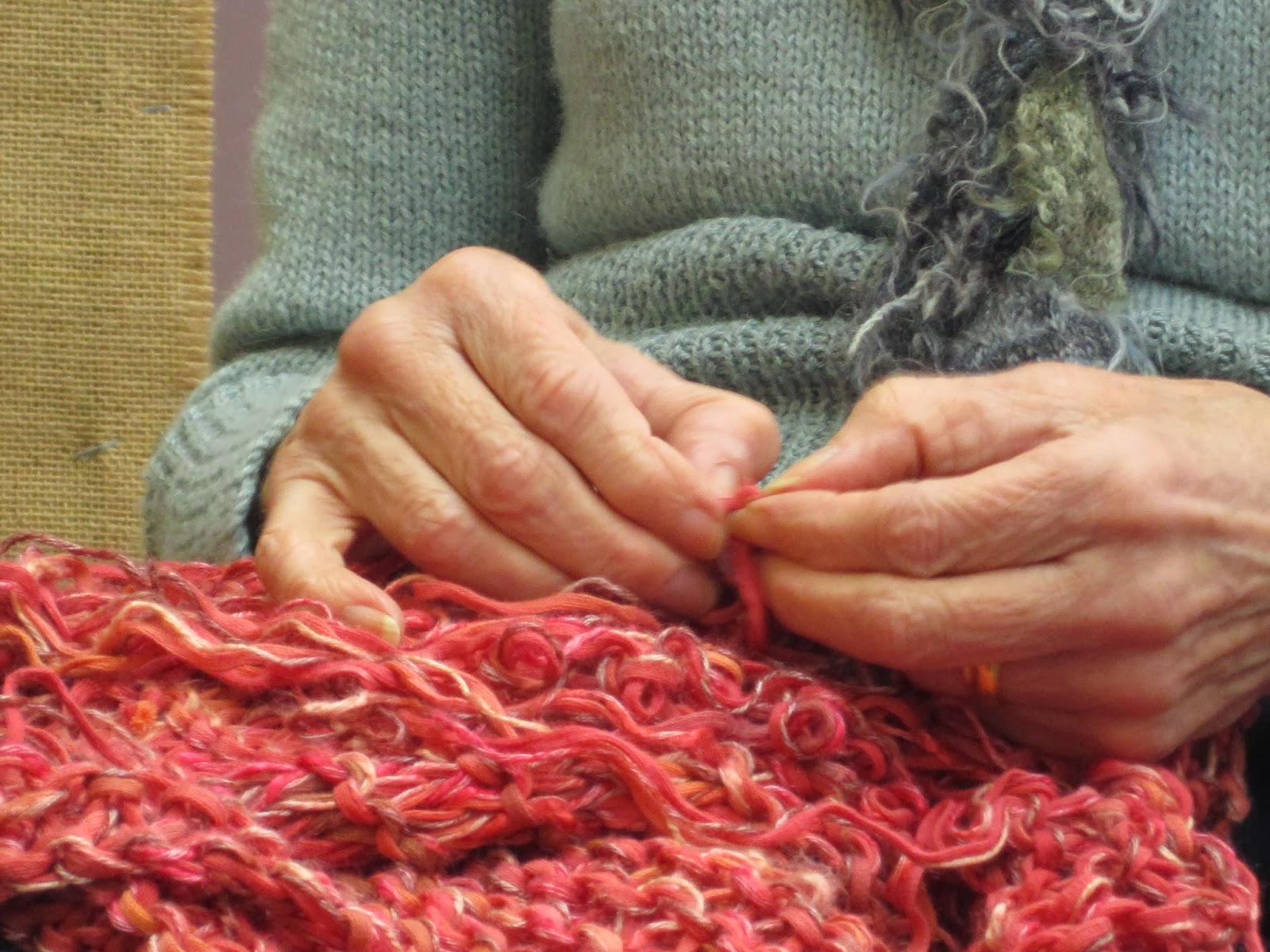
This all fell in place during my winter residency at Scottish Sculpture Workshop this winter when I spoke with director Nuno Sacramento about art as creating spaces for making and sharing and with American artist Jane Brucker about her performance art project Unravel. Through her project Jane hopes to assist people to let go and expand the way they think, for example, about the tension patterns in their bodies. Since starting this project, a range of artists has collaborated with Jane to create Unravelling performances. During her stay at SSW she invited me to write a poem.

As the road meandered through Donside on the way to Lumsden and the low winter sun lit the snow on the hills and made the river glisten, I tended to listen to a recording by actor Paul Scofield of T. S. Eliot’s Four Quartets. To be fair, I probably only half-listened, moving in and out of really paying attention depending on the condition of the road. The recording became a soundtrack for my journey, the cadencing of the voice a mesmarising soundscape interspersed with words repeated at intervals to anchor my thoughts.

Last week Jane and I held an Unravel event with two knitters and several passers-by at the shop Alba Yarn in Alford. After an introduction on letting go, each participant started unravelling one piece of knitting and eventually rolled up the yarn into a ball. While they were doing so a silence unfolded during which I read the series of poems I called Meditation, once straight through and then in a different order to create new narrative and meaning. After finishing my reading the silence continued. What stood out for me in the discussion that ensued eventually was the idea that the timbre of my voice and the rhythm and cadences inherent in the poem, did helped participants to let go. Without this soundscape, however, they would have continued their thoughts as usual.

Though our time at SSW is over, Jane and I hope to continue our collaboration over the next year or two. In the nearer future, however, I hope to continue developing my methodology of performing  my poems in ways that encourage the creation and recreation of meaning collaboratively.

Unravelling.
Here two extracts from Meditation:

Few – the words
I use to portray
The craft of a creator;
The knitting needle
Like the quill I write with
Expressing the habit of hands.
Many – the meanings
Expressed through those words;
Like a collage of colours
A knitter can choose from;
Meanings through words
Arranged and arranging
Created and creating.

***
Creating and recreating
Are both the seed of creation
And creation germinating in unravelling.
If all creation is becoming
All creation unfolds.
What might be seen as one act
Unfolds as performance.
Creating and recreating,
The end a new beginning
In the play of time.

Copyright text, poem and image Petra Vergunst

Tuesday, 11 February 2014

What is in a poem?

Right from the moment I composed my first music, I have enjoyed working in this medium. Every note expresses emotion, and the difference in emotional charge between successive notes generates drama. This ability of music to express drama  perhaps culminated in my chamber opera Highland River. However much I enjoy composing music, I have felt increasingly frustrated with the expressive possibilities available in the medium of music. Though the title of a work and programme notes can illuminate what a piece of music is about, instrumental music itself has little opportunities to express ideas behind it. To acknowledge this, my community music work has always contained an element of words, be it as song lyrics or poetry. In answer to my frustration about the limited ability of music to express conceptual ideas I developed the idea of a winter residency at Scottish Sculpture Workshop to explore the expressive opportunities of poetry in its own right, and identify ways in which I can use poetry as a medium in community arts projects.

Whereas music is based on sound, poetry is a medium based on words that are either heard or read. The series of poems I wrote for my residency at SSW were composed for performance. As written last month, when performed poetry shares many characteristics with music, not least because of rhythm, rhyme and repetition. Yet, poetry uses words to create images. What’s more, in their book Studying Poetry, Matterson and Jones argue that poetry can be thought of as a way of thinking in images and liken it to visual arts. In A New Bucket, for example, I used the image of a bucket to illuminate the dreams families might have cherished about life in town. Like music, poetry often unfolds through a series of images. In A New Bucket I have used the contrast between the pail the used in the cottage and the plastic bucket the mother would get in town to create drama and depth. 

A New Bucket
Mother would get a new bucket, she said,
Once father started his job in town
A new bucket mother would get
Filled with maternal feelings and foam

The new bucket would be unlike
The pail in the cottage
No more dents, harsh clanging
Troubled water killing soap
No more heavy pails
Engrained in mother’s hands

The new bucket would be plastic, mother said,
Plastic would dampen thuds
And the bubbles on the clean water
Would celebrate days out in the park

Mother would get a new bucket, she said
Like auntie Betty was given
When she moved her expanding family to town
To chase bubbles.

My residency at SSW has been an inspiring experience. Among the things I’ll take away are the joy I have experienced writing poetry, the ways in which imagery can be manipulated to express conceptual ideas, and the ideas I developed for future community arts projects involving poetry. Next up will be an exploration of poetry as a medium in arts-led inquiry.

Copyright text, poem and image Petra Vergunst

Tuesday, 28 January 2014

Pottery and claypipe

The third week of my winter residency at Scottish Sculpture Workshop and I've drafted all poems I intended to write. Today, I spent some time reflecting on the overall theme and narrative of the poems. I am thinking of The Music That Dances, the working title I have given them, as a series of poems inspired by the idea of a woman visiting her cousin in search of family stories. In a way, it is the story of one family leaving the land in search of a better life in the city whilst relatives stay behind and the growing gap between these two families in terms of the life they live and the way they relate to the land where they have their roots. Longing to fill in what is written between the lines of records of birth and death, the daughter of the family who left for the city visits her cousin and asks him to take her to the house where she was born. Here is one of the poems:

 
Pottery and Claypipe
Digging up the story
Buried beneath the stones
Unravelling layer by layer
Pottery and claypipes
Used by the men and women
Who played their fiddle at ceilidhs
Turned hay in the fields

The story builds up
As my trowel brushes away
Yet another sheet of soil

Like an archaeologist
Evidence I’m looking for
Evidence of stories passed
On to me by mother, grandmother
Evidence of lives lived
Of stories burning inside
Shared by neighbours around the fire

Pottery by claypipe, the story
Buried beneath the stones
Builds up, layer by layer

Copyright text, poem and image Petra Vergunst

Friday, 17 January 2014

The music of poetry

Most people consider poetry and music to be distinctly different art forms with the expressive qualities of poetry deriving from the narrative and meaning created by words whilst the expressive qualities of music arise from the emotions, atmospheres and drama expressed through sounds. Through words poets can express exactly what their work is about. Composers, on the other hand, lack this opportunity. These people would thus argue that poetry and music are distinctly different. I couldn’t agree less. In this blog I will present one counterargument by exploring the music inherent in poetry.

Working on Wind, Willow, Water revealed the proximity of poetry to music. When I wrote this poem I was not only looking for words that would describe the floodplain, I also wanted the poem to sound well, to be full of rhythm and tension. But even more music inherent in the poetry surfaced when even I recorded the poems. The heightened speech that I used to recite the poem emphasised pitch, rhythm, dynamics - and silences. Together this created the pattern of climax and relaxation similar to that what a composer is looking for in his or her music. The soundscape of the video poem Wind, Willow, Water thus not only consisted of the sounds created on a treble recorder, it also consisted of the music created by the poem.


In creating a poetic soundscape for Wind, Willow, Water I noticed that at times the actual meaning of words was less important than the sound and rhythm they elicited. The very title, for example, consists of three words that alliterate on the letter w to create an undulating and fluid experience. As these words are repeated, the meaning of these words gradually become less urgent than their sound and the imagery those sounds conjures up. Other poets have worked with onomatopoeia to create a similar effect. The poet Billy Letford (see video, copyright William Letford), for example, opens his poem There's Hunners O Burds On The Roofs with made-up words that, I imagine, resemble the sound of a flock of starlings on the roof of a building in a city. 

The landscape between poetry and music is a continuum on which the performance of poetry can be a musical affair that, at times, goes beyond the meaning at times. During my residency at SSW I want to explore the landscape between the two poles to find my own way to express the music inherent in poetry and, ultimately, to create a poetry performance that sings like music.

Copyright text Petra Vergunst

Tuesday, 14 January 2014

Darkness and isolation

A new year and new challenges. The first two months of 2014 have brought the exciting opportunity of a residency at the Scottish Sculpture Workshop in Lumsden to develop a piece of performance poetry as part of their winter residency programme.

The theme of the winter residency programme, ‘Darkness and Isolation’ raises a lot of questions. What kind of isolation are we referring to? Isolation can be physical, environmental, social, political. Some kinds of isolation can be factual, many other kinds are more a feeling, an experience, a perception. Isolation is also a relative concept and we need to ask ourselves in relation to what we feel isolated. These questions are particularly important to me as my background is in rural development. Surely, living in remote rural communities can be isolated in a physical sense, but I question whether inhabitants necessarily feel isolated socially and culturally. The Land Reform legislation has even taken a step towards addressing issues of political and economic isolation by giving communities the opportunity to buy land hand and thereby take control over a communities’ destiny. Though many communities feel this may be too big a step, this legislation may effect their experience of political and economic isolation. At the same time, city living can be an isolated experience as many people hardly know their neighbours and the less well-off are marginalised. The poet Meg Bateman captures this particularly well in her poem Remoteness in which she describes where you can find remoteness nowadays: “in the towerblocks between motorways/where people are removed,/ edged out from power”.

As part of my project Said in Stone last summer, I wrote around twenty poems in which I tried to capture the experiences and stories related to stones of a variety of real and imagined people in Grampian. When I reflected on these poems it struck me that, in one way or another, most of the poems dealt with issues of – what I call – embeddedness, that is, the experience of belonging to a certain place, time and community. To me, embeddedness and isolation are head and tail of the same coin. Though equally contested, I feel that embeddedness may have more positive connotations than isolation. During my residency at SSW I will thus use the term isolation to respond to the theme ‘Darkness and Isolation’.

To add to the art forms that I can use in my community music work, and because I enjoy writing, I’ll work in the medium of performance poetry during the residency. When I wrote the poems for Said in Stone and for the video poem Wind, Willow, Water, the musicality of poetry stood out for me. In carving out my own approach to performance poetry I want to capitalise on this musicality and borrow ideas from performance art about ways in which perceived barriers between a performer and the audience can be broken down through the creative use of space and giving the audience a role in the performance. I will showcase my work during an informal performance on Friday 14 February at SSW.

Other posts about the residency at Scottish Sculpture Workshop are:
The music of poetry 
Pottery and claypipe
Copyright text and image Petra Vergunst