Tuesday, 12 March 2013

Site-specific

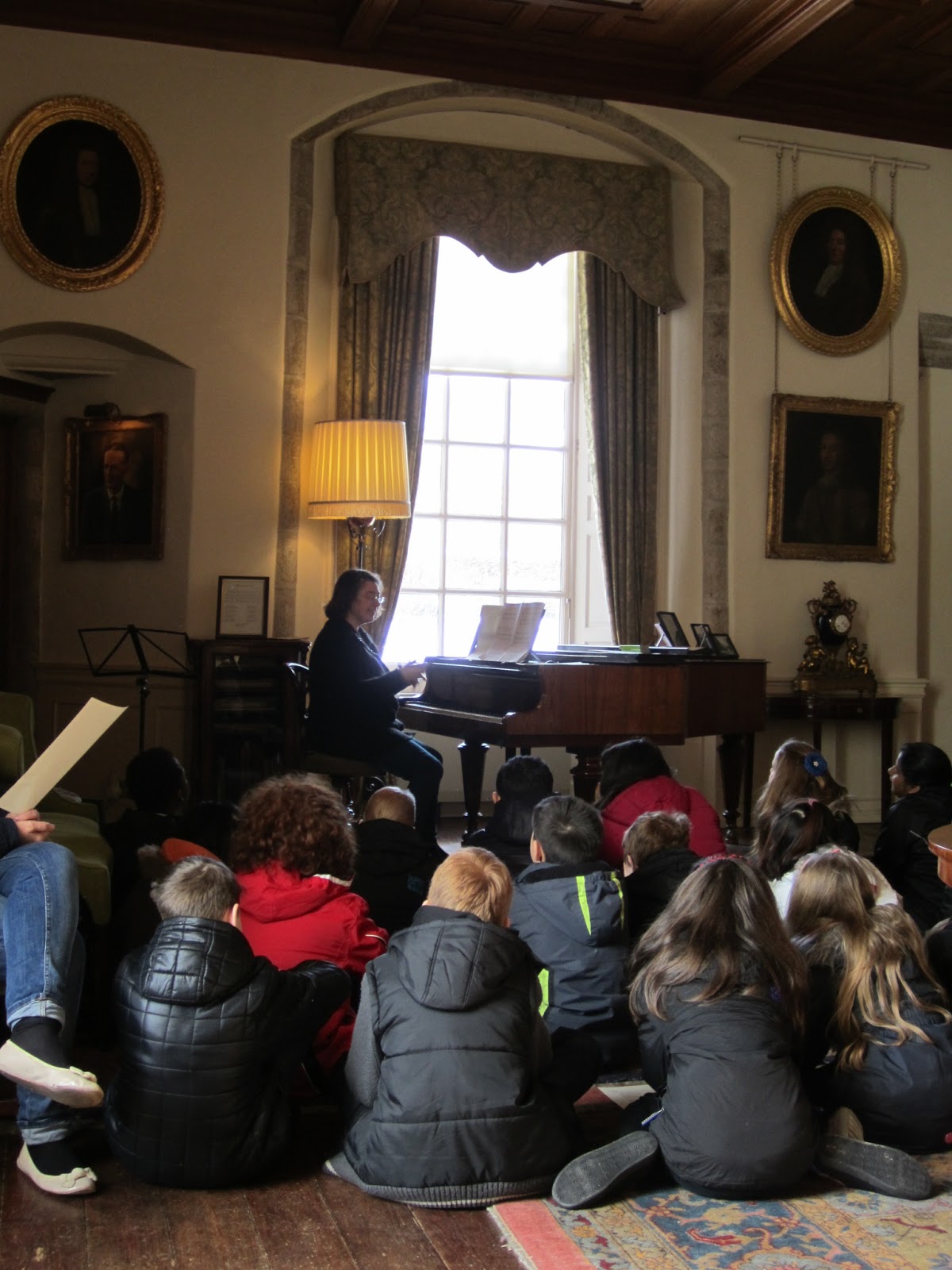
One of the common threads in my community music practice is that the place that inspired the music is also the place where it is rehearsed and performed with participants. In the Warp and Weft project at Verdant Works, the music, inspired by the jute industry of Dundee, was rehearsed in a former mill. In Hear the Drum, a project with the National Trust for Scotland, the music inspired by the Tower of Drum was sung and acted out with school children in the castle earlier this week. 

In October, I participated in Out of the Box, a weekend of site-specific opera performed in lighthouses, horse stables, hotel apartments and pubs. Pippa Murhy’s opera Bolted, about the tension that may arise when a young woman loves her boyfriend as well as her horse, was performed in a stable. The ambiance and physical properties provided by the stable replaced the need for scenery and props that might have been needed if the opera had been performed in the more traditional opera setting of a theatre. Yet, the opera could have been performed in any stable. This is not to deny that the stable contributed significantly to the ambiance of the opera, but it was merely the physical properties of the space that did so, not the history and personal stories engrained in the place. In contrast, the site-specific music I compose for rehearsal and performance in my community music projects has this extended link to place. School children thus sung and acted out scenes that were inspired by the history and stories of the tower of Drum.

So what are the merits of engaging with music that is inspired by the physical properties, history and stories of the place in which it is rehearsed and performed? Mapping the Terrain, a book about new genre public art edited by Suzanne Lacy, opens with a picture of a women, obviously a passer-by, standing still to read some of the text that is being written on the pavement by artists. This image captures the essence of site-specific music as well: the creation of an experience for participants or the wider public that makes a place memorable. 

During the first two days of workshops with primary schools at Drum Castle this week, children left the room chatting about who would be King Robert the Bruce. During the lunch break, I heard some other children singing ‘Open the doors!’. Through the music of Drum I’ve been able to tell the story of how Drum became a place to be reckoned with. Through singing, talking about the historical events, and acting out the scenes, Drum Castle became a memorable place for the children.  

  Copyright text Petra Vergunst
Pictures taken by Laura Paterson (National Trust for Scotland)

Thursday, 7 March 2013

Curves and hollows


Coming from the dense plantation, Pitcowdens opens itself up as a field scattered with broadleaved trees and stone structures. Owned by the Forestry Commission Scotland, it can only be approached on foot. Birdchatter and treefelling in the distance are the only sounds to break  the silence. When I volunteered for Friends of Durris Forests several years ago, I used to visit this abandoned forest croft regularly. Since then, the heritage project  has come of age. The tumbled down stones of the house and byre still lie where they used to be. I had forgotten about the wooden fence poles on the wall that used to border to garden. The treehut and willowhide are new and will certainly be a hit with my sons. Yet, it is a new bench that stops me in my track.

The bench might well have been a sculpture. The curves and hollows in the planks have Hepworth-like qualities. Held up by granite stones, I wonder about the symbolism of this structure. Wood and stone as the essence of a forest croft. At the same time I feel a sense of irony: are the planks really being supported by the stone? Once the croft was the home of farmers, gamekeepers and woodcutters, but as the it was abandoned in the middle of the 20th century the link between the house and the woods was broken forever. 

When I sit down to write down my first impressions I realise that the bench is placed on a viewpoint. Against the backdrop of the plantation I can just about distinguish remnants of dykes in the distance. Once, Pitcowdens was an active farm where man and horse ploughed the fields. Archives show that the family who lived on the farm used to have a ploughboy. When I put down a cup of tea from my flask next to me I notice the rusted hook in the stone that flanks the seat on the right. What was the hook used for? Could the Clydesdale horses in the byre have been tied up to it overnight?

Though it is early March the sun has not come out and I feel the bitterly cold wind. I get up to see whether there are any objects that could help me tell the story of the abandoned croft. The forest school has left some branch structures that remind me of the kind of washboards that must have been used at Pitcowdens to wash clothes. When I return to the bench I take some pictures of the concentric patterns of cracks in the planks to inspire some abstract drawing. My eyes then fall on the views seen through the holes in the planks. Upright oval shaped, the hollows frame a narrow portion of the fields and plantation behind. I move a little bit to the left and right to find my favourite view. The holes in the planks seem to grow on me. Could it be that what I see when I visit Pitcowdens is only a small part of the stories that are written in the stones of the abandoned croft?

You can listen to the music inspired by my experiences of this heritage site at the blog Pitcowdens.

Copyright text and images Petra Vergunst

Wednesday, 27 February 2013

Said in stone

Neil M. Gunn’s novel Highland River tells the story of a northern river that is the pivot around which the central character’s Kenn’s physical and spiritual development resolves. On their way to poach salmon upstream the young Kenn and his older brother Angus pass the ruins of some old croft houses. Angus tells Kenn that the shallow hollows in the land at a little distance from each other show that the land has been cultivated and that the short white wall in the distance is a burying ground.

“The folk who lived here long ago. They lived in the ruins there, and in other ruins you’ll see. They poached the river many a time, I bet!” 

For Angus the abandoned croft houses evoked memories, enhanced by his imagination, of the people who inhabited the moorland in the past, and he passed this collective memory on to his younger brother. In his Foreword to the catalogue of Will MacLean’s Collected Works 1970-2010, Duncan MacMillan writes that memory is the moving part where time past and time present intersect. The old croft houses remind Angus of the people who lived there in the past, and the lives they lived. By imagining that these people must have poached salmon many a time just like the two brothers are about to do, these snapshots of collective memory gain renewed significance in the present. It seems as if the very stones of the abandoned site have messages written in them which can be deciphered by those who know how to read the landscape.

Stones lay scattered all across the Scottish landscape - ruined crofts, dykes, churches, bridges, stone circles. This year I intend to uncover some of the memories and imaginations such stones evoke through musical, visual and written media. Not only do I want to read some of the stories embodied in stone, I also want to develop my understanding of the way memory links past and present, and the way working across various arts disciplines can help me in this arts-led enquiry (see also my blogs Composition, Repetition, and Taking Inspiration from Sally Beamish). 

Expressing myself musically, visually and verbally will give me insight in the crossovers between the ways different forms of arts think about what they do and how they do it. In comparison to the visual arts and writing, music is often thought of as being an abstract art and therefore most suitable to appeal to people’s emotions and imagination. In his book The Music of Painting, Peter Vergo explains how this quality, as well as the structured approach of musical composition, appeals to many painters. As a composer of music my interest is in the reverse: how thinking visually and verbally can provide an extra dimension to music composition. 

As a student with the Open College of the Arts I've noticed that drawing and painting students keep sketchbooks in which they explore ideas on a regular basis, even if this does not feed directly into a drawing or painting they're working on. In contrast, composers seem to sketch mainly to feed into particular compositions. I want to borrow from the visual arts the idea of keeping a sketchbook to record my field work. My musical, visual, verbal and conceptual observations will all feed into my larger enquiry, and this in turn will provide context and inspiration, and hopefully some starting points for specific musical compositions.

For now, I’ll follow in the footsteps of Kenn and Angus, be it with camera and sketchbook in hand, to uncover some of the memories and imaginations the stones scattered across the landscape evoke.

Copryight text and image Petra Vergunst

Links to other blogs for the project Said in Stone:

Wednesday, 13 February 2013

Frozen river

 A walk along the river in the midst of winter. The sun will soon disappear behind the hills. The air is thin. Upstream, deep snow covers the slopes towards the river. Here, footsteps have smoothened the snow on the river path. Still silence. No mid-register gurgling of the water that gives a glimpse of the inner voice of the river. Only when one tunes in to it, one hears the higher-pitched lisping of the ice. The strong current prevents the river from freezing over. Instead, ice crystals float on the currents. Underlying voices reveal themselves by continuously changing the ice crystal’s orientation on their journey downstream. Circles embedded in a line. 


The inspiration for Frozen River, a composition for glockenspiel. piano and cello, comes from one of composer Petra Vergunst’s many wintry walks along the river Dee in the Northeast of Scotland. She uses the glockenspiel and whole-tone scale to evoke the experience of the thin air on a cold mid-winter afternoon whilst the cello captures the voice of the river.  

Composer Petra Vergunst works as a community musician whilst studying Advanced Music with the Open College of the Arts. Interested in a wide range of environmental, social and cultural issues, and working across the arts, Petra often combines her musical compositions with narrated and/or sung texts to express the experiences and thoughts behind her compositions. To reinforce the narrative character of her music she likes to resemble her musical utterances with spoken ones, and arranges them in the form of a dialogue. Conscious choices of traditional key relations and/or atonal techniques, sometimes in combination, help her express underlying intentions.

In the arrangement for flute, trumpet and cello, Frozen Rover was played by The Red Note Ensemble at Noisy Nights in Edinburgh and Aberdeen. In an arrangement for glockenspiel, piano and cello, the composition came runner-up in a competition by the Open College of the Arts Student Association.

Copyright text and music Petra Vergunst

Monday, 28 January 2013

Woods of Drum

Woods of Drum has been written as part of Hear The Drum, a community music project commissioned by the National Trust for Scotland to engage more people with the work of the trust. In Woods of Drum, Mary Irvine writes a letter to a friend in which she shares her concerns for her brother Alexander, the 17th laird of Drum, who has marched off with Bonnie Prince Charlie's army to fight at Culloden. In the mid-1700s, Mary took over the management of the estate when her brother was fighting the Jacobite cause. She was particularly interested in the management of the woods and is reported to have written: "I lang wish my brother to be at more pains to propagate trees about Drum as I think they might be profitable as well as pretty."

White anenomes spring up between decaying autumn leaves
The sun on tender green leaves
Blackbirds serenade.

A new beginning.

Alexander fights on Charlie's side.

Alexander?

Days are getting longer
Leaves unfolding.

A new Scotland.

Battle, battle.
Nightmares.
Battle, battle.

See that robin perched on that branch
His song so warm
Red is its breast.

Alexander, are you alive?


Copyright text, words and music Petra Vergunst.

Friday, 23 November 2012

Drum

The first of two compositions for Hear the Drum, the community music project commissioned by The National Trust for Scotland is now finished. The music will debut on Saturday 1 December at another musical community event. The community are invited to come along and play their part in bringing the newly-written music to life for the first time. Drum tells the story of the first Laird of Drum's arrival in the Royal Forest of Drum. Here is the libretto and music.


King Robert the Bruce:
William de Irwyn, clerk in the Royal Chancellory,
On behalf of my kingdom,
I appoint you my representative in the Royal Forest of Drum.
The tower will be yours,
The power of life and death.

William de Irwyn:
An honour,
The King has granted me his land.
The tower, the forest, the law, the law.

I, I represent the King!
They'll open the door, guiard the tower.
Deer will roam the woods.
Life and death be in my hands. 

The people:
Open the door, open the door,
Open the door for the first Laird of Drum.

William de Irwyn:
The King sent me,
To serve the King you shall serve me.
The Royal Forest of Drum is my kingdom.
I shall order, I shall reign,
Open the door.

The people:
Open the door, open the door,
Open the door for the first Laird of Drum.

 
Copyright text, image, libretto and music Petra Vergunst

Friday, 16 November 2012

Opera out of the box

A few weeks ago I had the pleasure of being part of Out of the Box, a weekend of small-scale site-specific opera that is part of Sound 2012, North East Scotland’s Festival of New Music. Alex Reedijk, Scottish Opera’s General Director, concluded a panel discussion at the end of the weekend with the observation that the future of opera lies in shorter productions as new audiences are more likely to try out something new when it is not a sit of several hours. A recent survey by Tete-a-Tete: The Opera Festival for Arts Council England shows that there are around 200 opera companies in England, mostly outwith the subsidised sector. One in five of their productions are 21st century works. One can now genuinely say that opera is as vibrant as ever.

Yet, opera seems to have unleashed itself from conventions and out of the box productions are becoming increasingly common.  Earlier this week I heard Vicky Featherstone, Artistic Director of The National Theatre of Scotland explain how her organisation had performed within a 20 mile radius from most of Scotland’s population. In order to bring theatre to people, the theatre had performed in village halls, pubs, car parks. Opera has taken inspiration from site specific theatre. Site specific opera lets concrete settings inspire the drama, and performs in situ by making the site the stage. If anything, the opera weekend of Sound 2012 revealed that site-specific opera plays around with many of our expectations of what opera is and should be.

In Out of the Box, operas were performed in pubs, hotel rooms, stables, on a bus and in a lighthouse. Many of the spaces were small and performers were physically close to the audience. In many cases the audience were even an essential element in the production. The Sloan’s Project by composer Gareth Williams and librettist David Brock, was an opera that took place in a pub. The acts took place in different parts of the pub, and in one act I was that close to the singer that I had to be careful not let her trip over my feet when she moved around the piano. This being a pub scene, the audience gathered around tables or hang about at the bar. The audience was surrounding –even mingling with -the performers from all sites. The audience had become pub-goers and thereby part of the staging of the opera production. Being within reach of the performers meant that their facial expressions, gestures and movements were watched closely, and from all sides.

The site-specific operas during the opera weekend were all small-scale productions of an hour at most. To fit in the lighthouse keeper’s bedroom at the Museum of Scottish Lighthouses in Fraserburgh, composer Gareth Williams had scaled down his number of performers for Last One Out to a baritone and string trio. On a bus tour to visit this opera, there was even an one-man opera performed by actor, baritone and cellist Matthew Sharp. Being small-scale productions the operas also revealed a new take on the role of musicians in opera. Traditionally, musicians take their hiding in the pit from where they provide the necessary instrumental scenery. In Out of the Box operas the musicians were on stage, and playing an active role in the drama.  The most interesting example of this was in Bolted by composer Pippa Murphy and librettist Ben Nicholson, a work for countertenor, soprano and cello. At times, the cellist took on the role of horse through acting a horse with his whole body. In a scene in which the soprano expressed her love for the horse, the cello had became the voice of the horse with the singer and cellist basically entering a duet.

To me there was one opera that epitomised site-specific opera in all its facets: Faustus by composer Stephen Deazley and librettist Martin Riley. At one moment during the bus tour the bus stopped alongside a woodland. From between the trees a rather tatty looking man emerged, cello in hand (actor, baritone and cellist Matthew Sharp). The bus driver opened the door for him after which the man greeted us passengers with an aria before telling his story whilst the bus continued its journey. In a rather confused state of mind the man gave away his cello, bow, his wallet and passport, and his jumper before jumping off the bus and walking away in the fading afternoon light into another woodland.  Whereas in grand opera the start and conclusion of an opera is marked by the opening and closure of the curtains, Faustus, like many of the other operas in Out of the Box, had fluid openings and endings. Applause at the end of performances were fluid as the audience wasn’t sure when the opera had actually finished. Faustus ended with the librettist (who nobody expected to be part of the plot) running behind the tatty looking man, putting his long black coat over the performer’s shoulders and walking off into the fading afternoon light next to him. The conclusion of this opera was a strong image, an eerie silence in the bus, and no one to hear the applause as the performer was outwith hearing distance.

There was a real buzz around the opera-weekend with audience members actively discussing the merits of the site-specific operas performed. Opera is as vibrant as it has ever been, be it out of the box. It is up to us composers to engage with it. 

Copyright text Petra Vergunst