The creative experience workshops for the community music
project Burn of Sound, commissioned by Scottish Natural Heritage, have now
taken place. Finzean, Logie Coldstone and Ballater primaries are rural
schools and their pupils were clearly at home in the outdoors environment of
Muir of Dinnet National Nature Reserve. The creative activities encouraged the
pupils to observe, listen, feel, smell and imagine and write down their
experiences in poetry and prose. In the end of the workshop each pupil was
invited to write down their best writing on coloured pieces of paper that
were collected in a sketchbook. The result has been an imaginative account of the children's
nature experiences.
Reading through the pupils’ contributions to find material
for the rounds, three things stood out. The children’s writing showed a wide
vocabulary to describe their experiences. The ‘I spy’ activity generated long
lists of words which were arranged in different combinations to make little
sound pictures. The letter B, for example, allowed for the little poem ‘Burn,
Bridge, Bank, Boulder’. At other times, pupils used simple words to capture evocative imagery. After looking for tadpoles in a boggy patch along Burn o’Vat one pupil wrote: ‘I felt moss, I held water’.
The writing also revealed unlimited imagination and ability
to go beyond themselves. In one of the activities the children were asked to
imagine they were the burn and describe their experiences. One pupil described the flow of the burn in the following manner: ‘Drifting
downstream, turning, swirling, around and around, away in the blink of an eye’.
During the workshops it tended to be sunny but blustery and
this came through in much of the writing. The pupils were very attentive as to
the effect of the wind on the trees and water and found a wide range of ways to
describe this. I have included some of these observations in the round Wind
Whispers (click here to listen to the tune: http://www.youtube.com/watch?v=8SukJMEplsU)
Wind whispers
Leaves flutter, branches sway
I feel free, I feel free
Free when the wind blows down on me.
As part of the workshop, children were also asked to listen for
the pitches and rhythms of the sounds in The Vat. In the round The Vat I’ve
created a sound picture of the gorge (click here to listen to the tune: http://www.youtube.com/watch?v=YaPEdiD1q1g):
Many artists spend time in ‘the field’ to inspire their art.
Be they painters, writers or musicians, the intimate experience and
understanding of the place generated through spending time outdoors is
essential for producing studio work. When the writer Robert Macfarlane and jazz
musician Arnie Somogyi were asked to produce a performance piece for Orford Ness in Suffolk, the two artists spent days and nights in the nature reserve,
keeping notes of images, phrases and other splinters of found language, jotting
down sharts of melodies and half-heard harmonies.
In doing so, they came to know the place by heart. As a result, the artists’s
understanding of the nature reserve not only permeated the content of the
performance piece but also informed its structure. What is interesting to me is
that in their fieldwork Macfarlane and Somogyi tended to stick to their own
medium, crossing the boundaries of their art forms primarily through
collaboration. Though I am mainly a composer, I have a keen interest in writing
and drawing. Producing images, words as well as sounds in fieldwork, I am currently exploring how doing fieldwork in more than
one medium influences how I experience and understand a place.
Images, words and sounds help me to experience and
understand a place in different ways. In his book The Perception of the
Environment, anthropologist Tim Ingold
argues that art gives form to human feeling. The way in which we express this
human feeling is guided by our ‘specific orientations, dispositions and
sensibilities that we have acquired through having had things pointed out to
us’. From teachers and books, artists have learnt how to do fieldwork in their
own discipline. I argue that our experience and understanding of the place is
filtered through the medium we work in. When I did fieldwork at the ruined forest croft of Pitcowdens I not only tried
to think in images, words and sounds, I also reflected on how each of these mediums
influenced the way I came to experience and understand the place.
I started my fieldwork at Pitcowdens with taking photographs
that contained interesting movement and contrasting textures. There were also
images that could serve as a peg through which I could tell the story of the
forest croft – hollows in planks that shaped my view of the forest croft.
Searching the site for interesting objects I realised that the objects I was
looking for had to help me add a human dimensions to the generic story of a
forest croft being abandoned. A twig structure resembling a washboard helped me
conjure up images of women washing clothes. The stories, ideas and imaginations
evoked through exploring images became the subject matter for some creative
writing. In the process of finding the right words, the intangible amorphous images
firmed up.
There are composers who write music inspired by specific
places, but fieldwork remains a less common phenomenon for musicians than it is
for painters and writers. The routines for doing fieldwork are also less well established,
leaving composers the opportunity to find out for themselves how they would
like to develop their experience and understanding of place – and how this is
to influence their music. For the performance piece for Orford Ness, jazz
musician Arnie Somogyi wrote down snippets of melodies and harmonies that came
to his mind whilst being in the reserve and produced music based on improvisation,
composition and environmental sounds. On what he calls a song-walk along the
river Deveron, musician Jake Williams collects images and songs native to the
valley of the river Deveron, recording some of the songs on location.
My own ideas for the composition Pitcowdens developed gradually, away from the ruined
forest croft. The experiences and understandings generated through my fieldwork
influence my musical ideas as well as the larger structure in which these were
presented (compare the work of Sally Beamish). The images, words
and sounds created during my fieldwork at the ruined forest croft, and the particular
experiences and understandings of this place these brought about, have thus shaped
my composition Pitcowdens.
As part of the community music project Burn of Sound for Scottish Natural Heritage there will be an opportunity for people
who enjoy the visual arts, writing and music to reflect on the kind of
experiences and understandings of place they develop through fieldwork. The
workshop, a walk with creative writing
exercises followed by a discussion, will take place on Saturday the 11th
of May from 2 to 4 pm at the visitor centre in the Muir of Dinnet National Nature Reserve. If you want to
participate in this workshop, please send an email to Petra Vergunst at petravergunst@hotmail.com.
Holes left where branches once extended the trunk sideways
Shape our view
Of the forest croft
Then – a placed lived in
Now – reliving the place through our imagination
The image of holes in the planks of the bench once again takes me back to
my experiences at Pitcowdens. By stepping a little
bit to the left and to the right, the holes in the planks gave me different views of Pitcowdens. On my way back to the car, it gradually emerged to
me that my favourite view would be imagining the ruined forest croft from the viewpoint of a
bothy ballad. Bothy ballads, a kind of folk song traditional to North-East
Scotland, are the songs that used to be sung by unmarried farm labourers. After
browsing through several volumes of songs of life and love, I found The Dying Ploughboy. In a similar way as Marian Leven considers her pictures to express remembered feeling,
I felt that this song captured the feelings Pitcowdens triggers for me.
In The Dying Ploughboy, one of the farmworkers feels his end
is near and says farewell to his master and the land he used to work:
Fareweel my nags, my bonnie pair,
I'll never yoke and lowse ye mair,
Fareweel my ploo, wi you this hand,
Shall turn nae mair the fresh red land.
I have often felt that the ploughboy not only bids farewell to his
master and the land, but ultimately also to a way of life and working the
land. Before gamekeepers and forest workers lived at Pitcowdens, the croft was a farm.
As farming gradually retreated to the more fertile, lower-lying grounds along
the river Dee, the forest took over. In the end, the estate was handed over to
Forestry Commission Scotland.
In Pitcowdens, a composition for flute, oboe, bassoon, horn
and cello, I have tried to express some of the memories and imaginations
conjured up by Pitcowdens. When the land around Pitcowdens was farmed, the
farmer had farm helpers who would have sung bothy ballads like The Dying
Ploughboy. I have taken the first four notes of this song – the sequence of the
dominant, mediant, subdominant and dominant – as a motif to base Pitcowdens on. The
opening bars, repeated several times, suggest my observation at Pitcowdens that ultimately gave
rise to the series of feelings and imaginations in the composition. One may detect a sense of
longing, the rhythm of working the fields, and a more lyrical scene that
alludes to the bothy ballad. In the final scenes the different feelings and imaginations merge into a more rounded perspective.
I have written Pitcowdens as part of the project Said in Stone.
Below the composition:
Pitcowdens was shortlisted in a competition by the St.
Andrews New Music Ensemble and played by the ensemble in a
workshop with Sally Beamish.
Golden birch leaves rustle in the disappearing sun while
silver drops scar the reflecting surface of the water.
The above words came to my mind when
resting on a bench alongside a small lake an early autumn
a few years ago. I used words to describe a nature experience and express my
emotional response to it, perhaps even using my imagination to conjure up new
experiences. Irrespective of the kind of experience I had and the words I used
to capture it, the very act of writing has made the experience a memorable one. The creative activity has etched it in my mind.
The community music project Burn
of Sound, commissioned by Scottish Natural Heritage to celebrate the
Year of Natural Scotland 2013, aims to use the creative
activities of writing and singing to deepen the participants’ engagement with Muir of Dinnet National Nature Reserve. One cannot only capture nature
experiences through the meaning of words, but also through the rhythm and sound
of words. The meanings and musical qualities of words can be further enhanced if
set to music. A selection of the material written by participants during
creative experience workshops in the first part of the community music project
will therefore be integrated in a series of rounds that will be sung with
participants during singing workshops in the second half of the project.
The project Burn of Sound will start with a series of
creative experience walks that start from the Muir of Dinnet visitor centre –
for schools on Monday 29 April and Wednesday 1 May and for families and on Saturday 11 May from 10.30 am to 12 noon. During
those walks participants will be encouraged to use the meaning, rhythm and
sound of words to capture their nature experiences. Families will have an
opportunity to sing the rounds based on the material written during the
creative experience workshops at the Muir of Dinnet visitor centre on Saturday 15
June from 10.30 to 11.30 am, whereas local schools and community groups will be offered singing
workshops in the week starting 17 June in schools and the venues where they
usually gather.
Parallel to the work with schools, families and community
groups, the community music project will provide an opportunity for local
artists, writers and musicians to explore how they, in their creative practice,
engage with their natural world and if their experience would be different if
they engaged through a different art form. This creative experience workshop
for artists will take place on Saturday 11 May from 2 to 4 pm. The subsequent singing
workshop, in which there will be an opportunity for further reflection will be
held on Saturday 15 June from 2.30 to 4 pm.
If you are a family, school, community group or artist interested
in participating in the project, please contact community musician Petra
Vergunst at petravergunst@hotmail.com.
For more information about the project you can also contact Muir of Dinnet
reserve manager Catriona Reid on Catriona.Reid@snh.gov.uk.
One of the common threads in my community music practice is that
the place that inspired the music is also the place where it is rehearsed and
performed with participants. In the Warp and Weft project at Verdant Works, the music,
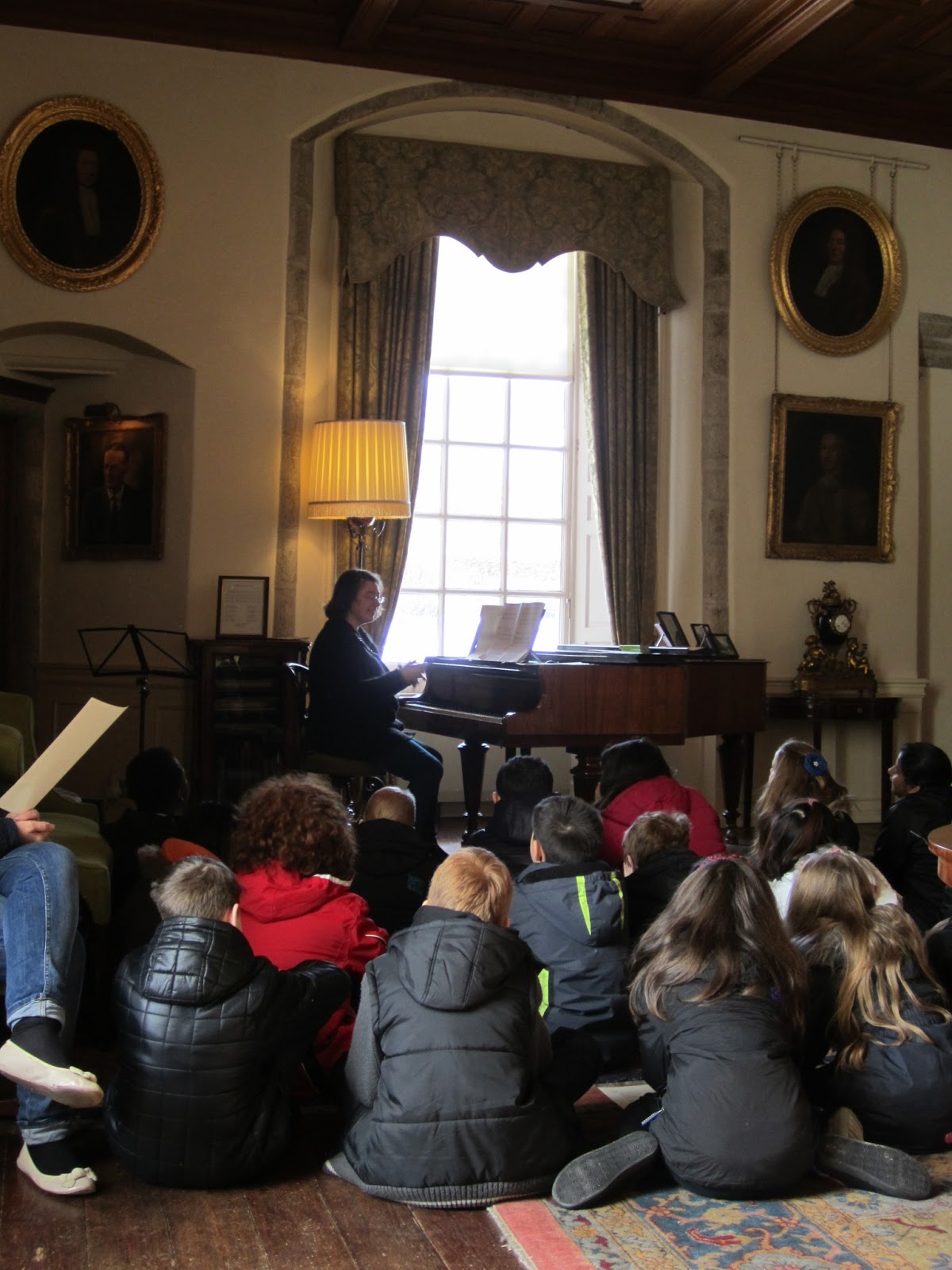
inspired by the jute industry of Dundee,was rehearsed in a former mill. In Hear the Drum, a project with the National Trust for Scotland, the music inspired by the Tower of Drum was sung and acted out
with school children in the castle earlier this week.
In October,I
participated in Out of the Box, a weekend of site-specific opera
performed in lighthouses, horse stables, hotel apartments and pubs. Pippa
Murhy’s opera Bolted, about the tension that may arise when a young woman loves
her boyfriend as well as her horse, was performed in a stable. The ambiance and
physical properties provided by the stable replaced the need for scenery and
props that might have been needed if the opera had been performed in the more
traditional opera setting of a theatre. Yet, the opera could have been
performed in any stable. This is not to deny that the stable contributed
significantly to the ambiance of the opera, but it was merely the physical
properties of the space that did so, not the history and personal stories
engrained in the place. In contrast, the site-specific music I compose for
rehearsal and performance in my community music projects has this extended link
to place. School children thus sung and acted out scenes that were inspired by the history and stories of the tower of Drum.
So what are the merits of engaging with music that is inspired by the physical properties, history and stories of
the place in which it is rehearsed and performed? Mapping the Terrain, a book
about new genre public art edited by Suzanne Lacy, opens with a picture of a
women, obviously a passer-by, standing still to read some of the text that is being written
on the pavement by artists. This image
captures the essence of site-specific music as well: the creation of an
experience for participants or the wider public that makes a place memorable.
During the first two days of workshops with primary schools
at Drum Castle this week, children left the room chatting about who would be
King Robert the Bruce. During the lunch break, I heard some other children singing ‘Open the doors!’. Through the music
of Drum I’ve been able to tell the story of how Drum became a place to be reckoned
with. Through singing, talking about the historical events, and
acting out the scenes, Drum Castle became a memorable place for the children.
Copyright text Petra Vergunst
Pictures taken by Laura Paterson (National Trust for Scotland)
Coming from the dense plantation, Pitcowdens opens itself up
as a field scattered with broadleaved trees and stone structures. Owned by the
Forestry Commission Scotland, it can only be approached on foot. Birdchatter
and treefelling in the distance are the only sounds to breakthe silence. When I volunteered for Friends of Durris Forests several years ago, I used to visit this abandoned forest
croft regularly. Since then, the heritage project has come of age. The tumbled down stones of
the house and byre still lie where they used to be. I had forgotten about the
wooden fence poles on the wall that used to border to garden. The treehut and
willowhide are new and will certainly be a hit with my sons. Yet, it is a new bench
that stops me in my track.
The bench might well have been a sculpture. The curves and hollows
in the planks have Hepworth-like qualities. Held up by granite
stones, I wonder about the symbolism of this structure. Wood and stone as the
essence of a forest croft. At the same time I feel a sense of irony: are the
planks really being supported by the stone? Once the croft was the home of
farmers, gamekeepers and woodcutters, but as the it was abandoned in the middle
of the 20th century the link between the house and the woods was
broken forever.
When I sit down to write down my first impressions I realise
that the bench is placed on a viewpoint. Against the backdrop of the plantation
I can just about distinguish remnants of dykes in the distance. Once,
Pitcowdens was an active farm where man and horse ploughed the fields. Archives
show that the family who lived on the farm used to have a ploughboy. When I put
down a cup of tea from my flask next to me I notice the rusted hook in the
stone that flanks the seat on the right. What was the hook used for? Could the
Clydesdale horses in the byre have been tied up to it overnight?
Though it is early March the sun has not come out and I feel
the bitterly cold wind. I get up to see whether there are any objects that could help
me tell the story of the abandoned croft. The forest school has left some
branch structures that remind me of the kind of washboards that must have been
used at Pitcowdens to wash clothes. When I return to the bench I take some
pictures of the concentric patterns of cracks in the planks to inspire some
abstract drawing. My eyes then fall on the views seen through the holes in the
planks. Upright oval shaped, the hollows frame a narrow portion of the fields
and plantation behind. I move a little bit to the left and right to find my
favourite view. The holes in the planks seem to grow on me. Could it be that
what I see when I visit Pitcowdens is only a small part of the stories that are
written in the stones of the abandoned croft?
You can listen to the music inspired by my experiences of this heritage site at the blog Pitcowdens.
 Stones