Wednesday, 28 January 2015

Gormack Burn

Another bank
 Another          
               view 
                                            meandering

How do you generate ideas for creative writing? How do you, after deciding upon the theme, develop a story?

My creative spark in Following the River is Neil Gunn’s book Highland River, but the way in which I will respond to it is only emerging to me slowly. What really stands out for me in the novel is the way the main character Kenn explores the landscape of Dunbeath Water, the landscape that frames and framed his childhood experiences. A walk along Dunbeath Water is certainly something I aspire to, but my walk will be very different from that of Kenn’s as I lack the intimate connection with that landscape. My experience of the strath will be that of a stranger.
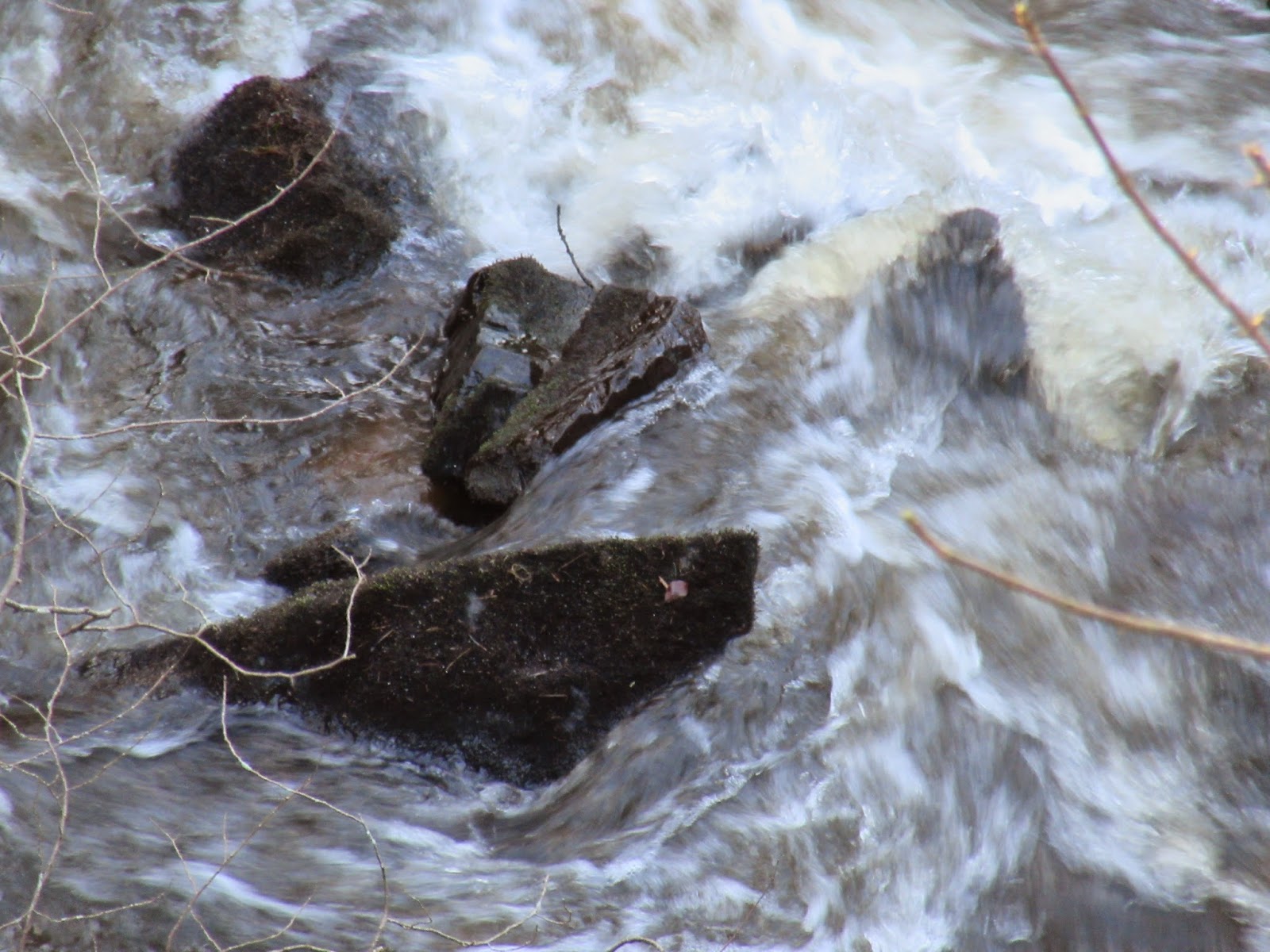
I thus need another strategy to explore the idea of walking along a river - I need to find a river that I know well. The landscape around my home is infused by rivers. To the south, the river Dee carves its way east towards the North Sea. Contributing to this river are many burns, among which Culter Burn, an important spawning ground for salmon. The papermill that used to dominate life in Culter up to the 1970s has, however, dammed this burn a mile upstream. Last autumn, a fish ladder was installed just behind my house and the first salmon have explored their way up north along Leuchar Burn and their way up west along Gormack Burn. Interestingly, both of these burns find their source on the foothills of Hill of Fare.

To emulate Kenn’s experience of walking to the source of a river with which he is intimately acquainted, I have decided to walk Gormack Burn from its junction with the river Dee to its source on Hill of Fare. Though I have often encountered this burn on my many walks, I have actually never followed its course as such. By taking pictures and making sound recordings, and by writing poems, my experience of following the course of the river is intensified and my awareness of the river is lifted from something I take for granted to something I’m highly aware of.

Earlier this week I did my first walk along Gormack Burn. The poems this walk generated capture observations, atmospheres, thoughts. I expect the walk along the entire course of the burn to take  around six days, and to generate a series of poems. Among these poems I hope to find the spark that will ignite the storyline for my script.

Copyright text, poem and image Petra Vergunst

Tuesday, 6 January 2015

New arrivals

To get inspiration for Following the River I have been exploring Loch of Skene the last few weeks.

Journeys
As the autumn evening settles
smoke from scattered chimneys
lies low over fields
cotton warmth
merges with October woods

A walker labours
carved forest paths
to the shores of the loch

The weight of the day’s journey
suppressed by feet
scurrying tired leaves
in storm-strangled groves

Fourteen hours it took geese
to navigate the ocean –
that morning, as they left Icelandic lands
the walker set off
to reach the edge of the water
in time to greet the new arrivals.

Copyright text, poem and image Petra Vergunst

Following the river

A new year, a new beginning.

As the final project for my composition studies with the OCA two years ago, I composed the chamber opera Highland River based on Neil Gunn’s novel of the same name. The idea of journeying – daily journeys, away from one’s childhood landscape, to the source of the river – that is central in this novel  has continued to inspire me. And this was how I started my conversation with Dunbeath Preservation Trust who celebrate the work of Neil Gunn. Two years on this will result in a year-long poetry and composition project around the idea of journeying along a river. Kenn, the main character of Highland River, salmon and geese will be my travel companions. Part of my creative work will take place in Dunbeath, part of in Aberdeenshire river landscapes around my home.

A new beginning. Sparks from previous years have ignited Following the River.

As part of this project I shall be working towards a performance during the annual Light in the North Festival organised by Dunbeath Preservation Trust around the birthday of Neil Gunn in November. In the course of the year, however, I hope to share ideas, compositions and poems in progress as part of performances, readings and walks.

Other blogposts for Following the River:
New Arrivals
Gormack Burn
Poetry as document
Gunn's modern pilgrimage

Copyright text and image Petra Vergunst

Thursday, 18 December 2014

Wish list


November 14
I am raking autumn leaves when father
asks me to give him
my wish list for Christmas
carefully acknowledging each leaf in my pile

This Christmas I want magic
like golden foliage twirling
a twinkling cover of brown earth

This Christmas I want the magic
of opening a present
and feeling like a child
ripping off ribbons and paper
to see whether Father Christmas
has acknowledged his letter

Yet I know,
if I don’t give a list
another pair of socks
will be added to the pile
that I will rake next autumn.

Copyright poem Petra Vergunst

Monday, 3 November 2014

The Miller o' Hirn


A miller, his wife, his son, the mill wheel - and a composer. The ingredients key to Family Business, a contemporary reinterpretation of four of James Scott Skinner’s strathspeys commissioned by sound for soundlab. The music takes performers and listeners on a visit to the Mill o’ Hirn to meet the miller and his family and the Banchory-born fiddle player and composer. Like the original strathspeys are shared informally amongst communities involving various instrumentations, Family Business is composed as a flexible score to cater for the ever-changing group of people who make up soundlab, Aberdeen’s new music ensemble led by clarinettist Jo Nicholson. The work culminates in a session in which the musicians improvise on the original strathspey to emulate the constant renewal and reinvigoration of traditional music by communities past and present. 
                                                       
Family Business is part of a series of composition projects through which I hope to highlight the rootedness of traditional music in communities and places and the dynamic music scene resulting from this, and the inspiration that contemporary classical music can take from this.

Drawing on the four strathspeys by James Scott Skinner and the nursery rhyme The Miller of Dee, the actual score I composed consists of a structure for improvisation. soundlab had its first rehearsal of the work yesterday and I am very enthused to see how the piece has shaped up. A big thanks to Jo Nicholson and the wonderful musicians, and a big thanks to sound for giving me the opportunity to write and stage this work.

The performance of Family Business will be on Sunday 16 November at 4 pm at the Phoenix Hall at Newton Dee Village, Bieldside, Aberdeen. The event is free and tickets are not required. 

Copyright text and images Petra Vergunst

Wednesday, 24 September 2014

Poetry walk pictures

My friend Yiannitsa Cegarra took some pictures during the poetry walk at Bennachie. In her photos she wanted to respond to some of the poems I was reading. Thanks Yiann!

Pearls

One in the late summer birch wood
Knee-deep in heather flowers

the trees' small heart-shaped leaves
glistened at the sun after a summer shower.

Beneath it a spider cobweb
spun between blaeberry twigs
hung heavy with heaven raindrop pearls.


I remember this in the same way
as the shelled settlement

a few strides further up the path
so as to not to forget

what kindled the squatters' fire.


Copyright poem Petra Vergunst, copyright images Yiannitsa Cegarra

Tuesday, 23 September 2014

Family Business

A composer, a miller, his wife and son, and the mill wheel – the ingredients of a new piece I’m composing for soundlab, Aberdeen’s new music ensemble led by clarinettist Jo Nicholson for a performance on Sunday 16 November.

On of the most interesting moments during my project Burn of Sound at Muir of Dinnet was when during a walk I took my participants to the viewpoint from where one can look over Loch Kinord. It was here that we met Paul Anderson who, for the project Atomic Doric that he was involved in, was composing a number of fiddle tunes inspired by the loch. He generously played some of his tunes for us.

This was a chance encounter that set me thinking. If Paul Anderson, a celebrated fiddle player and composer, found inspiration for his music in the area in which he lives, who was I then as a composer of contemporary classical music? The classical music tradition that informed my composition training suddenly seemed remote in both time and space. When we listen to a Haydn string quartet the music stems from a society and time distant from us. Moreover, here was Paul Anderson performing his music within touching distance, happily chatting with us in between tunes. No raised concert stage epitomising the untouchability and celebrity of performers of classical music as I was familiar with. Though I had long been aware of the different socio-cultural, geographical and historical relations in traditional and classical music, it was this meeting that really brought home it significance for me and questioned who I wanted to be as a composer.

The questions raised were still fresh in my mind when I spoke to sound last year about composing something for soundlab. With James Scott Skinner being a fiddle player and composer from Banchory the idea seemed obvious: what I would be looking for was a contemporary reinterpretation of some of James Scott Skinner’s music to highlight the way traditional music is inspired by our own environs and society and I was going to use this to revitalise my own contemporary classical music. In exploring the life and music of James Scott Skinner I was soon struck by a set of four strathspeys dedicated to the miller of Hirn, his wife, his son and the mill wheel. Hirn being just a few miles northeast of Banchory, I imagined the composer visiting his miller friend of many occasions.  

Family Business is composed for soundlab, a contemporary music group with a flexible group of musicians playing a wide range of orchestral, traditional and lesser known instruments (including voice). The work will be programmed alongside some traditional tunes and we are looking for some traditional musicians to join soundlab for this performance to help us get to grips with strathspeys and reels. If you want to join us, please contact Anne Watson at anne@sound-scotland.co.uk. There will be a rehearsal on Sunday 2 November from 10 am to 2 pm with a further rehearsal and performance taking place on Sunday 16 November from 12 noon to 5 pm. Both the rehearsal and performance will be at the Phoenix Community Centre, Newton Dee Village, Bieldside.

Copyright text and image Petra Vergunst